Now that you’ve identified your potential options, the next step is to evaluate them systematically. Decision-making can often feel overwhelming, especially when multiple factors come into play. A multi-criteria analysis (MCA) is a structured approach that allows you to compare and assess each option objectively. By doing so, you reduce uncertainty and ensure that your final choice aligns with your priorities and goals.

Why Multi-Criteria Analysis Matters?
When faced with a decision—whether in business, personal life, or project management—it’s easy to get lost in gut feelings or subjective biases. MCA helps you stay grounded by quantifying the decision-making process. Instead of making an arbitrary choice, you rely on a structured framework that considers all relevant factors.
By the end of this step, you should have a clear ranking of options, based on how well they align with your priorities. So, how do you execute an MCA effectively?
Use a Grading System
The first step in MCA is assigning measurable values to each option. A grading system helps you evaluate options based on different criteria, ensuring that you’re making a well-balanced decision.
Here are a few methods you can use:
- Numerical Scoring (1-10 or 1-100 Scale) Assign each option a score based on various factors like cost, feasibility, impact, and risk. A higher score should indicate a better outcome.
- Letter Grading (A-F) Similar to academic grading, you can assign A to the most favorable options and F to the unviable options.
- Traffic Light System (Green, Amber, Red)
– Green: Highly favorable
– Amber: Acceptable but has some trade-offs
– Red: Not a good option
The key is consistency—make sure you apply the same evaluation method across all options.
Compare Options Directly
Once you’ve assigned grades or scores, it’s time to compare the options side by side. A comparison table can be incredibly useful here. For example, let’s say you are choosing between three different marketing strategies for your business.
Your table might look like this using numerical scoring:
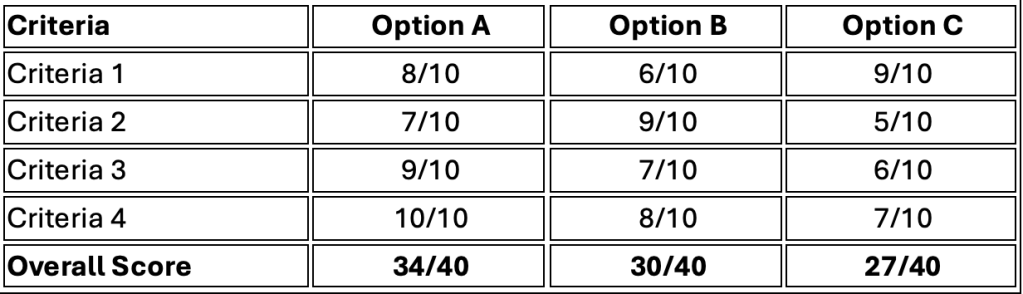
From this table, Option A appears to be the best choice because it scores highest overall.
If you’re dealing with qualitative factors, consider using a pros and cons list or ranking options from most to least favorable.
Prioritize Your Criteria
Not all criteria hold the same weight in every decision. For example, in a personal decision like choosing a vacation destination, cost might be less important than experience. In a business decision, ROI might outweigh implementation time. To refine your decision further, consider assigning weighting factors to your criteria.
For example:
Criteria 1: 40% weight
Criteria 2: 20% weight
Criteria 3: 20% weight
Criteria 4: 20% weight
Now, multiply each score by its weight:
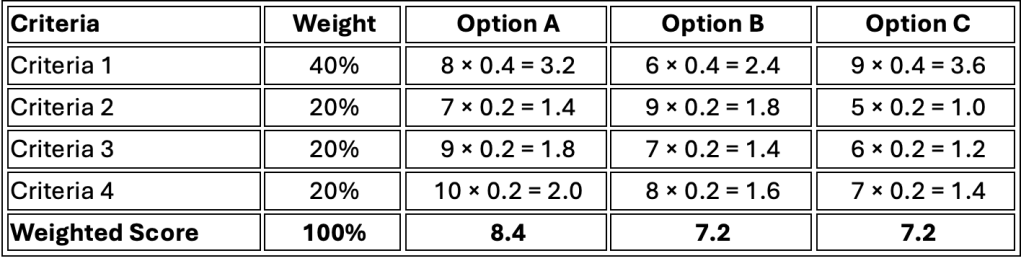
With weighted scores, Option A still appears to be the preferred option, but you can see how different priorities affect the rankings.
Consider External Factors and Risks
While numbers and scores provide clarity, don’t forget to consider external factors that might impact your decision:
- Market Trends – Is there an industry shift that could change your decision?
- Future Growth – Will this option be viable in the long run?
- Stakeholder Input – Does your team or audience have a preference?
- Potential Risks – What are the worst-case scenarios?
Sometimes, a seemingly perfect option might carry hidden risks. A good multi-criteria analysis doesn’t just focus on numbers but also strategic foresight.
How Do Your Options Stack Up?
By this point, you should have a clear understanding of how each option ranks. Whether you’re choosing between job offers, investment opportunities, strategic business moves, or planning a family vacation, a multi-criteria analysis takes the guesswork out of decision-making.
Now, take a look at your current decision—how do your options stack up? Are you seeing clear winners, or do you need to re-evaluate your priorities?
 The Barnes Perspective: Thoughts, Ideas & Lessons Learned from Joseph Barnes
Leave a comment