You’re in a project kickoff meeting.
Initial site plan options are pinned to the wall. Early schematic renderings glow on the screen. The room is filled with bright minds and good intentions. But when you ask a simple question—“What’s the process?”—the room goes quiet.
This happens more often than you’d think.
Too many real estate and community development projects launch with strong ideas but a vague path forward. Roles are unclear. Sequences are fuzzy. Design decisions become reactive instead of strategic.
The root issue?
The design process wasn’t designed.
One Size Never Fits All
Every project is different.
Some are long and layered—like a resort in an ecologically sensitive area. Others move fast—like a pop-up retail concept on an urban lot. Just like you wouldn’t pack the same bag for a walk to the corner store and a month-long trek through Patagonia, you shouldn’t approach every project with the same design strategy.
This is why the Strategic Definition phase matters so much. It’s where you align vision, purpose, and goals—and then tailor your design process accordingly.
You need to define:
- What kind of project this is
- What level of design control and detail is needed
- Who needs to be at the table—and when
That means adjusting the rhythm, tools, and team for each unique assignment. Because design management isn’t about oversight. It’s about orchestration.
The Four Quadrants of Impact and Investment
Back when I worked with Disney Development Company, serving as the Town Architect for Celebration, Florida, we used a simple framework that still guides my thinking today. We categorized projects along two axes: Dollar and Impact.
This revealed four project types—each demanding a different approach:
🟩 High Dollar / High Impact
Town centers, major public spaces, iconic buildings. These projects shape identity, catalyze value, and draw attention. They require careful visioning, iterative design, stakeholder engagement, and a multidisciplinary team of experts. This is where design leadership matters most.
🟦 High Dollar / Low Impact
Infrastructure, utilities, and back-of-house facilities. These are expensive but behind the scenes. The focus is on function, coordination, and durability. Expressive or symbolic design solutions are optional—not a priority.
🟧 Low Dollar / High Impact
Pilot programs, pop-up parks, public art. These are momentum builders—small investments with outsized influence. The process here should be nimble, collaborative, and adaptable.
🟥 Low Dollar / Low Impact
Signage refreshes, planter swaps, minor cosmetic updates. Sometimes necessary, but rarely transformational. These should be quick, tactical, and resource-light. Not everything needs a task force.
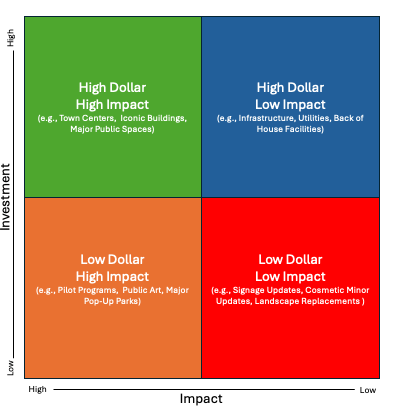
The danger? Applying the wrong strategy to the wrong quadrant.
Use a tactical approach on a signature civic space and you’ll fall short. Apply a full-scale architectural process to a planter refresh, and you’ll burn time and goodwill.
NEOM’s Structured Approach: Design Stages with Purpose
At NEOM, the asset design and construction process—as described in NEOM’s Plan of Work—was highly structured. It’s a model worth studying. NEOM mapped its design stages to internationally recognized frameworks like RIBA and AIA:
| NEOM Stage | Description | RIBA Equivalent | AIA Equivalent |
| Pre-Concept Design | Vision, feasibility, stakeholder engagement, site analysis, initial design exploration | Stage 0 – Strategic Definition | Programming / Pre-Design |
| Concept Design | Initial spatial concepts, massing, and aesthetics | Stage 2 – Concept Design | Schematic Design |
| Design Development | Refined architecture and systems coordination | Stage 3 – Spatial Coordination | Design Development |
| Technical Design | Construction-ready drawings and specifications | Stage 4 – Technical Design | Construction Documents |
| Construction | Execution oversight and quality assurance | Stage 5 – Construction | Construction Administration |
| Handover & Close-Out | Final inspections and building turnover | Stage 6 – Handover | Project Close-Out |
| Post-Occupancy | Monitoring, feedback, performance optimization | Stage 7 – In Use | Post-Occupancy Evaluation |
This structure ensured every team member knew where they were in the process—and what was expected at each step.
Lessons from Trojena: Right Talent to Task
Even though NEOM’s design process was well structured, it wasn’t always calibrated for the variety of assets we were designing and building at Trojena, one of NEOM’s most prominent development initiatives.
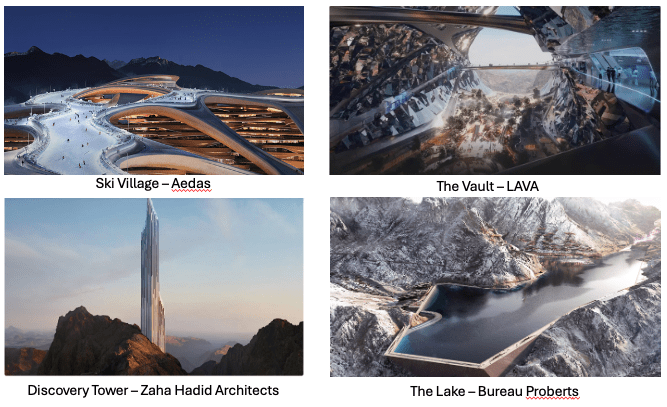
Trojena is a year-round mountain destination in northwest Saudi Arabia, developed at elevations ranging from 1,500 to 2,600 meters. It offers a unique blend of outdoor adventure, wellness, and luxury experiences—ranging from skiing and hiking to cultural events and high-end hospitality. Designed to be a global benchmark for sustainable and experiential tourism, Trojena fuses bold architecture, innovative infrastructure, and immersive natural landscapes to redefine alpine living in a desert climate.
As Trojena’s Director of Development Management – Asset Design, I helped shape the design strategy with a focus on long-term value and architectural integrity. With dozens of assets—each varying in complexity, significance, and timeline—we needed a flexible system to guide both who did the work and how it was delivered.
We developed two tools: Asset Classifications and Design Levels.
Asset Classifications
- Iconic – Unique, globally recognized, with a bold design narrative. Represents NEOM.
- Signature – Distinctive, but less globally recognizable.
- Class A – High strategic importance, socio-economic value, or complex design program.
- Class B – High investment value and medium-to-high design complexity.
- Class C – Medium-to-low investment or design complexity.
- Class D – Lower investment value or programmatic complexity.
Design Levels
We then created Design Levels (1–7), with Level 1 requiring the highest design control and Level 7 the least. Each asset was assigned a level—tailoring the process, team roles, and delivery accordingly.
Key Roles Across Design Levels
- Lead Design Consultant (LDC) – A creative lead with proven skills and alignment to NEOM’s design ethos. Required for Iconic, Signature, Class A, and B assets.
- Multi-Disciplinary Consultant (MDC) – Technical coordination across architecture, MEP, and engineering. Ensures compliance and constructability.
- Design & Build Contractor (D&B) – Capable of designing and building specific asset types, often leading in D&B delivery models.
- Design Architect (DA) – A design professional aligned with the project vision, often working as a subconsultant to the MDC or D&B.
Roles shifted depending on delivery methodology:
- Design-Bid-Build – Greater LDC involvement early on
- Design & Build – MDC or D&B leads later stages
- Hybrid / Early Contractor Involvement – Responsibilities were split strategically
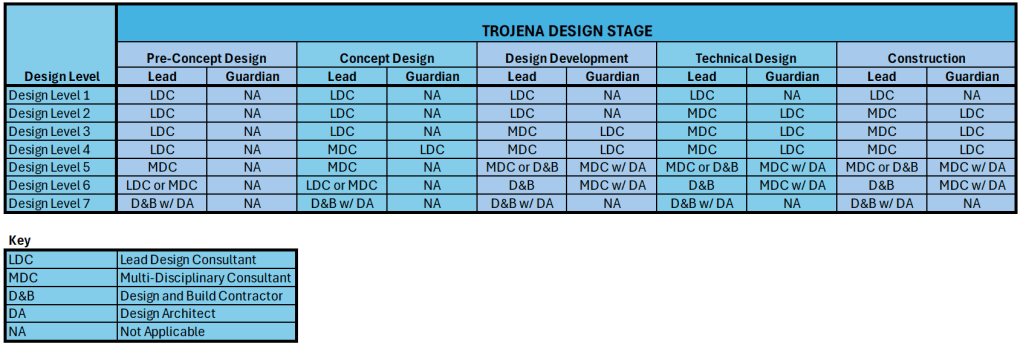
This matrixed model ensured the right talent was applied to the right task, intensifying design effort where it mattered most and streamlining where appropriate.
Final Thought: Customize With Intention
Not every building needs a starchitect.
Not every bench needs a branding workshop.
And not every design process should look the same.
What your project needs is a calibrated approach—one that reflects its purpose, impact, and risk. That’s what strategic design management brings to the table.
If you’re launching a new development—or frustrated with your current process—I’d be glad to help. Whether you’re leading a small team or steering a mega-project, we can right-size your design strategy and build a process that actually fits your project.
You’ve already defined the what.
Let’s design the how—together.
Curious if your current design process fits your project goals?
Let’s talk.
Reach out to me directly, and we’ll set up a time to walk through your vision and assess how your design process can support it—better. Smarter. More intentionally.
 The Barnes Perspective: Thoughts, Ideas & Lessons Learned from Joseph Barnes
Leave a comment