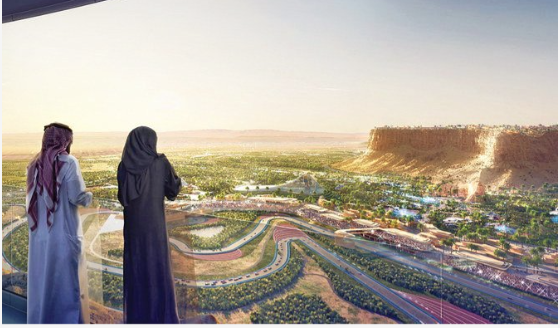
Framing the Question: How Much?
By this point, you’ve done most of the heavy lifting as part of the Strategic Definition stage of a project.
- You’ve clarified the Why by defining the project’s vision, purpose, and goals.
- You’ve mapped the Who—the people that matter—by identifying stakeholders and their interests.
- You’ve tackled the How, laying out a design strategy, roles, responsibilities, and approval pathways.
- You’ve figured out the What through a grounded market analysis.
- You’ve gotten honest about the site’s opportunities and constraints—Where you can build and, just as important, where you shouldn’t.
Now comes the question every developer and designer eventually has to answer: How Much?
That’s the role of the High-Level Development Program. It’s where ambition meets math, and it becomes one of the most critical tools in the Strategic Definition phase. It’s not a detailed building brief or a fully baked master plan. Think of it as a living framework—a shared outline that helps stakeholders test ideas, explore tradeoffs, and calibrate expectations. It gives structure to the conversation without locking in premature decisions.
You’re essentially building a working hypothesis, one that connects your goals, site realities, and market insights with space, scale, and function. You’re not guessing, but you’re also not over-committing.
Right-Sizing the Detail
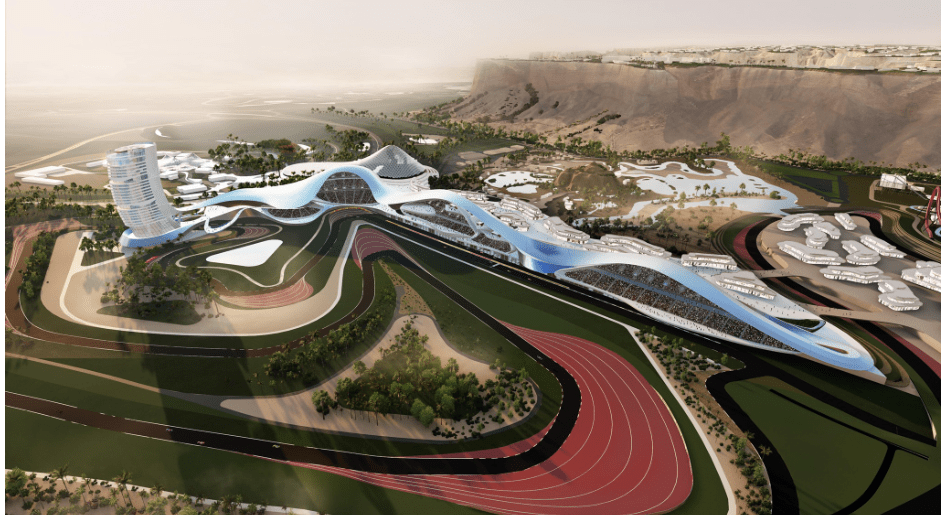
Not every project needs the same level of precision. If you’re mapping a low-density residential neighborhood, rules of thumb like dwelling units per acre (DUA) might be enough initially. But if you’re building something more complex, like a motorsports stadium and hotel inside a giga-project, you’re going to need more specificity. At Qiddiya, where I served as Executive Director of Planning & Design, we had to navigate exactly that.
The site for Motorsports Stadium and Hotel was located at the heart of Qiddiya’s Resort Core, adjacent to the F1 track, a water park, and a primary retail, entertainment, and dining zone. We weren’t just thinking about keys and square meters. We had to integrate hospitality, racing operations, media, trauma response, MICE programming, and ticketing systems—all while reinforcing Qiddiya’s brand as a regional entertainment and cultural capital.
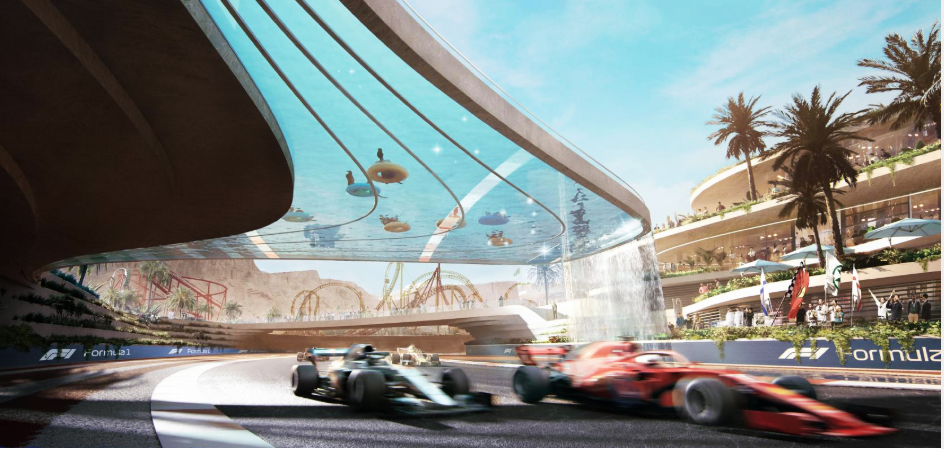
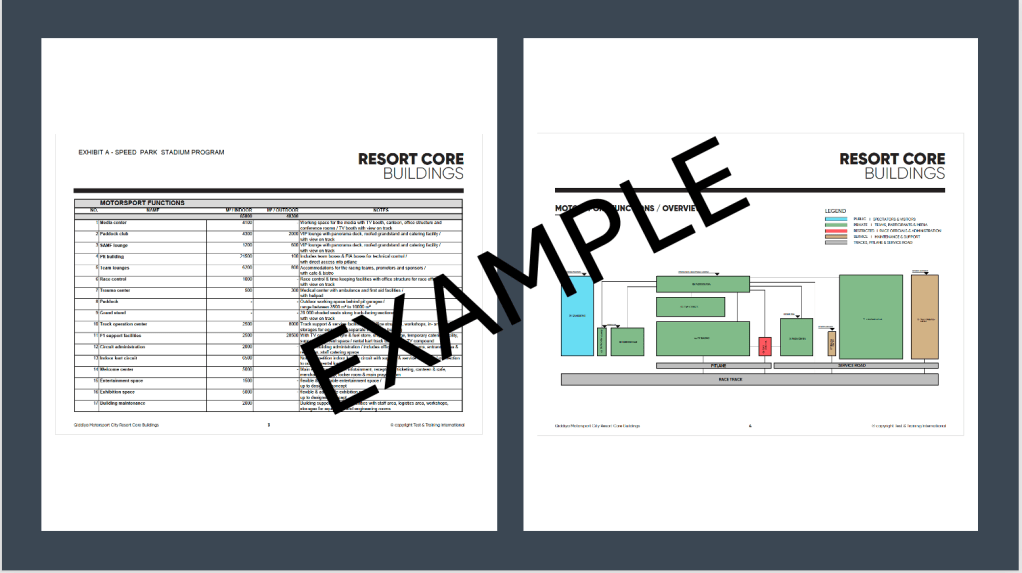
To make that work, our development program needed to break down the space into primary and supporting components, connect physical planning with operational realities, and provide a framework flexible enough to adapt as design progressed.
Core Elements of a High-Level Development Program
1. Vision Integration: Reground your team in what the project is trying to do. Are you creating a regional sports hub? An immersive nature retreat? A branded entertainment district? That vision should shape your decisions around size, mix, and use.
2. Primary Programmatic Elements: Define the major uses and spatial allocations. At Qiddiya, these included:
- Motorsports Hotel: 250 keys, 6,000 sqm of meeting space, 1,200 sqm of F&B, integrated robotic garage.
- Motorsports Stadium: FIA-grade trauma facilities, pit garages, public concourses, and, media zones.
- Indoor/Outdoor Karting: Shared welcome areas, changing rooms, and spectator zones.
3. Supporting Functional Zones: Include both front-of-house (FOH) and back-of-house (BOH) infrastructure:
4. Spatial Requirements: Estimate preliminary areas by use or level. Even ballpark figures help ground your thinking in reality. These inform massing, utilities, parking needs, and infrastructure planning.
5. Adjacency and Relationship Planning: Functional relationships matter. Map key adjacencies, circulation, access requirements, and buffer zones:
Operational Scenarios
Think beyond fixed uses. Plan for how the development adapts over time or by event type. At Qiddiya, we considered the following different events and activities, all impacting the relationship between key programmatic elements: circulation, access, and security.
- Race weekends (F1, MotoGP, etc.)
- Off-season driving experiences
- Corporate retreats and MICE events
- Brand activations and launch events
- Concerts, car shows, charity runs
This thinking informs spatial flexibility, security planning, guest movement, staffing, and revenue generation.
Benchmarking Comparable Projects
Use benchmarks to ground expectations and inform design direction. At Qiddiya, we referenced:
- Yas Marina Circuit and Porsche Experience Center for motorsports
- Dorint Nürburgring and Cachet Boutique Hotel for hospitality
- T-Mobile Arena and O2 Arena for multifunctional venue operations
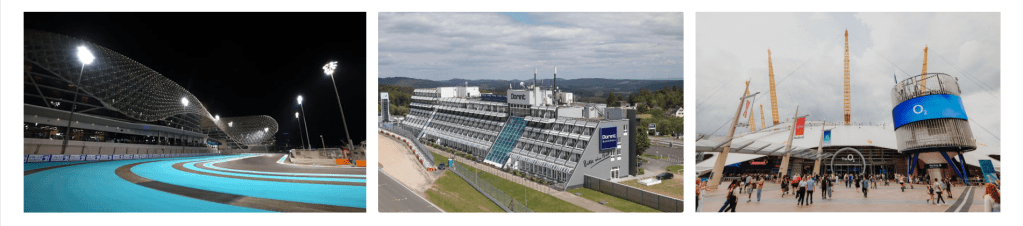
These references helped us align and manage expectations around sizing, operational needs, and guest experience. It helped to galvanize the operational and guest experience drivers and direction.
Yield and Fit Studies: Stress Testing the Program
Stress testing the High-Level Development Program is the critical reality check. A great-looking program on paper can quickly fall apart if it doesn’t fit the site or zoning envelope. Early-stage yield and fit studies help you determine whether your ambition aligns with physical and regulatory constraints.
Even a basic 2D or 3D massing diagram can make a huge difference at this stage. You can catch issues like:
- Overbuilding relative to allowable height, setbacks, or open space ratios
- Conflicting access points or inefficient circulation
- Insufficient space for essential support functions like deliveries, BOH corridors, or vertical circulation
More than once, I’ve seen projects try to squeeze an overambitious program into an undersized site, leading to compromises in design, operations, or guest experience. A quick test fit can prevent costly revisions down the line and can also unlock new possibilities—perhaps the program can be shifted, stacked, or phased differently.
Don’t just ask if the numbers add up. Ask if the experience still holds together once it’s been laid out in space.
Flexibility and Phasing
The High-Level Development Program isn’t the final word. It’s the starting point. Use language that allows for evolution:
- “Up to 250 keys” instead of “250 keys”
- “Between 15,000 and 18,000 sqm” instead of locking down an exact number
- Identify elements that can be phased or added later
Flexibility is strategic. It allows the development to respond to approvals, funding, and real-world demand without derailing the entire vision.
Why This Matters
A well-crafted High-Level Development Program helps align stakeholders around a shared framework, informs feasibility modeling and financial projections, guides your design brief and procurement strategy, and shapes how you talk to regulators, partners, and community members If done right, it becomes the project’s strategic backbone—not a straitjacket but a roadmap that brings clarity, confidence, and momentum to the development process.
So next time you’re asked how much, you’ll have an answer that’s grounded, flexible, and ready to move the project forward.
 The Barnes Perspective: Thoughts, Ideas & Lessons Learned from Joseph Barnes
Leave a comment