I remember sitting in a value engineering meeting years ago, watching as the sustainability features we’d worked so hard to integrate were sliced away line by line.
Solar shading? – “Nope. Too expensive.”
Greywater reuse? – “Nope. Maybe next time.”
Green roofs? – “Nope. Cut entirely.”
I wasn’t lost on the irony. This project proudly touted its environmental aspirations until cost-cutting rebranded them as luxuries.
If you have been following along on this series of articles focused on creating effective design briefs, you might think sustainability comes later in the process. It doesn’t. Your sustainability goals should be among the first items you define. Why? Because sustainability touches everything, including design decisions, budgeting, construction materials and methods, and long-term operations.
Sustainability also means different things to different people. For some, it’s LEED Platinum. For others, it’s reduced utility bills. Add the myriad programs and certifications worldwide, and sustainability quickly becomes misunderstood, undervalued, or dismissed as an unneeded expense. Integrating sustainability early drives value. It doesn’t just make you feel good. It makes financial, social, and environmental sense.
Why Sustainability Matters: People, Planet, Profit
You need to ask yourself a fundamental question: Are you designing it to comply with local codes or outperform market expectations?
Sustainability is about aligning your project with the triple bottom line:
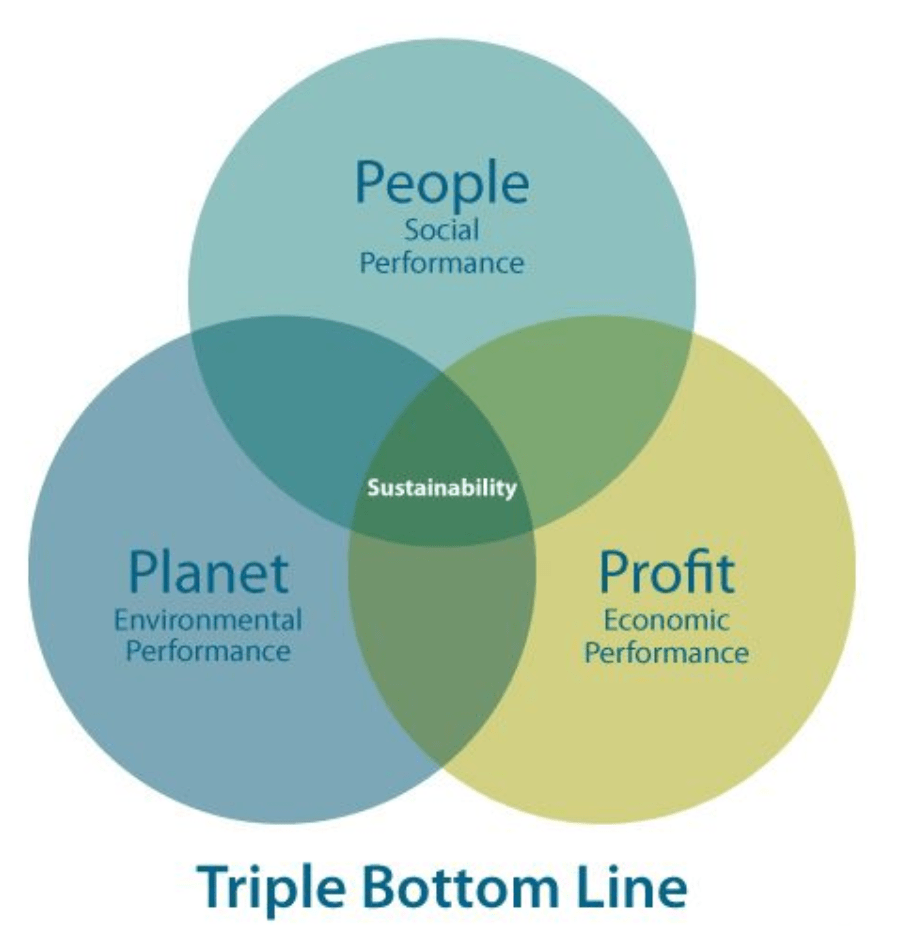
- People – healthier indoor environments, improved occupant wellbeing, better productivity.
- Planet – reduced resource use, emissions, and environmental impact.
- Profit – lower operating costs, higher market value, enhanced risk management.
Instead of just doing the minimum to be code compliant, imagine this scenario:
- Your tenants breathe cleaner air, enjoy daylight-rich spaces, and take fewer sick days.
- Your building uses 30% less energy, cutting operational costs and greenhouse gas emissions.
- When you go to sell or refinance, your sustainability credentials become market leverage, showing investors that your project is future-proofed.
Think about how it might impact your NOI.
Overcoming Resistance: Busting the Myths
On every project I have worked on where sustainability, despite being a top-down mandate with clear benefits, I still faced resistance from both internal and external parties. The genesis of this resistance came from four primary concerns.
Concern 1: “It costs too much upfront.”
That is the biggest myth. The reality? Lifecycle cost analyses consistently show sustainability investments pay back through energy and water savings, often within just a few years. In many markets, building green no longer costs significantly more, especially when integrated early. Beyond savings, there’s upside: higher rents, faster lease-up, improved occupant productivity.
Concern 2: “Our team lacks expertise.”
True, sustainability requires specialized knowledge. But training and collaboration solve this. It is best to start small by implementing some “low-hanging fruit” initiatives like LED retrofits or enhanced insulation, then graduate over time to more complex approaches such as renewable energy or advanced water systems. When starting, engaging experienced sustainability-focused consultants early to build confidence within your team is beneficial.
Concern 3: “It complicates design and slows construction.”
Only if it’s an afterthought. When sustainability targets are embedded from kickoff, design and construction flow smoothly. Integrated planning reduces rework, delays, and conflicts. Modern tools like BIM energy analysis streamline processes that once took weeks. When managed proactively, many projects achieve certifications without schedule impacts.
Concern 4: “No one’s demanding it.”
Perhaps tenants aren’t explicitly asking for LEED plaques, but they want comfort, lower bills, healthier air, and future-ready spaces. Investors increasingly demand Environmental, Social and Governance (ESG) -aligned assets. Cities are tightening energy codes and introducing carbon penalties. Being proactive isn’t just about leadership but about staying competitive and compliant.
Choosing the Right Sustainability Program
Selecting the right sustainability program can be downright confusing. There are many options, each with its focus, requirements, and certification process. What works well for a Class A office tower in downtown Chicago might not make sense for a boutique hotel in rural Virginia. The location of your project, the climate, and local regulations all play a part.
But it doesn’t stop there. The type of asset you’re building matters, too. Are you developing to hold for the long term, or is this a build-to-sell scenario? Your operational goals, the expectations of your investors or tenants, and your team’s capacity to manage documentation and certification all factor into what’s most appropriate. A program with rigorous energy modelling requirements can sometimes provide big operational payoffs if you hold the asset. Other times, a more straightforward performance-based approach is more practical when you’re working with production homebuilders on a fast-moving schedule.
Determining what sustainability program best suits your project and your team is where using a structured approach like the Decision Making Framework I’ve written about in The Barnes Perspective comes into play. By clarifying your project goals, stakeholder needs, operational priorities, and resources upfront, you can better evaluate which sustainability program aligns with your situation. It’s about making a choice that works for you, your team, and your project, not just picking the trendiest logo to stick on the marketing board.
Sustainability Programs for Commercial Assets
Choosing the right sustainability program for your commercial project isn’t just about earning a plaque for the lobby. It’s about aligning with your operational goals, tenant expectations, and long-term investment strategy while delivering real environmental and performance benefits.
Below are some of the most widely used programs for commercial assets, along with practical pros and cons to help you decide which approach makes sense for your office, retail, mixed-use, or institutional projects.
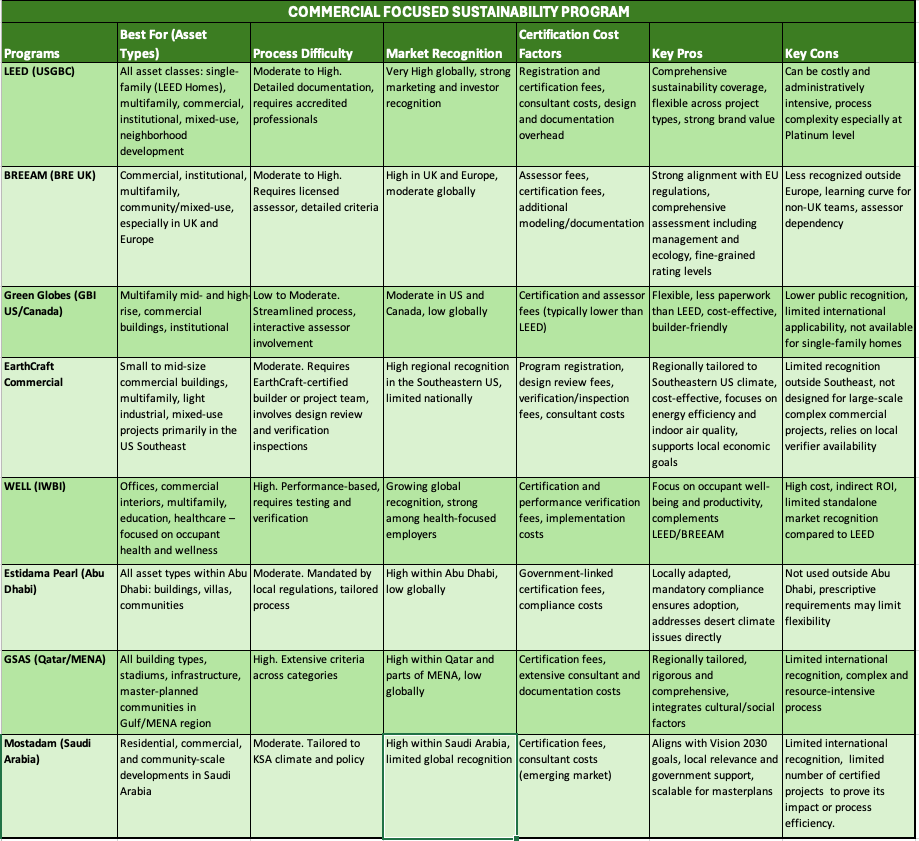
Leadership in Energy and Environmental Design. (LEED) – LEED offers global credibility. Investors, tenants, and municipalities recognize it as a mark of quality. Its holistic framework covers energy, water, materials, and health. But it’s documentation-heavy, requiring time, consultant expertise, and careful navigation to avoid chasing easy points over impactful strategies.
Building Research Establishment Environmental Assessment Method. (BREEAM) – BREEAM is widely recognized in the UK, Europe, and increasingly the Middle East. It aligns with EU regulations and emphasizes ecological impact and site context. Having a licensed assessor can streamline coordination. Outside Europe, however, BREEAM lacks brand strength compared to LEED.
Green Globes – Green Globes is a flexible, practical sustainability assessment system widely used in North America. Many developers appreciate its straightforward approach, lower certification costs, and the ability to integrate sustainability into standard project management workflows without excessive consultant time. However, Green Globes lacks the same level of global brand recognition as LEED, which can be a drawback if your project seeks international investors or tenants prioritizing globally recognized certifications.
EarthCraft Commercial – EarthCraft Light Commercial is focused on small commercial buildings up to 100,000 square feet. It integrates energy efficiency, indoor air quality, and site sustainability in a practical framework suited to smaller-scale offices, retail, and institutional buildings in the Southeast. Design and construction teams appreciate its focus on occupant comfort and lower operational costs without the intensive documentation requirements of LEED. EarthCraft Commercial’s brand recognition is limited outside its region and is not typically used for large commercial or institutional projects. EarthCraft best suits teams prioritizing practical, regionally optimized sustainability over global certification prestige.
WELL Building Standard. WELL – WELL focuses purely on occupant health, wellness, and productivity, some of the key priorities for corporate tenants today. Certification signals a commitment to employee well-being, boosting tenant attraction and retention. However, WELL is costly to implement and maintain and is best pursued alongside broader environmental certifications for a complete sustainability profile.
Estidama – Pearl Rating System – Estidama, the Arabic word for “sustainability”, is tailored for Abu Dhabi’s climate, prioritizing water conservation, energy efficiency for extreme heat, and cultural integration. Compliance is embedded in planning approvals. Outside Abu Dhabi, however, its recognition is minimal.
Global Sustainability Assessment System. (GSAS) – GSAS is rigorous, covering urban connectivity, energy, water, materials, and cultural value – ideal for Qatar and neighboring countries. Yet its international recognition is limited, and the process is consultant-intensive with a steep learning curve for teams unfamiliar with its requirements.
Mostadam – Mostadam, an Arabic word meaning “sustainable,” is Saudi Arabia’s national rating system. It aligns with Vision 2030 and integrates local climatic, cultural, and regulatory needs. It positions projects well for approvals and incentives in KSA, though brand recognition is still developing globally.
Sustainability Programs for Residential Assets
Choosing the right program isn’t just about which logo looks best on your sales brochure. It’s about aligning with your project goals, builder capabilities, and buyer expectations while delivering meaningful environmental and operational benefits.
Below are some of the most well-known programs for residential assets, along with a few practical pros and cons to help you determine the right fit for your homes, townhomes, or multi-family projects.
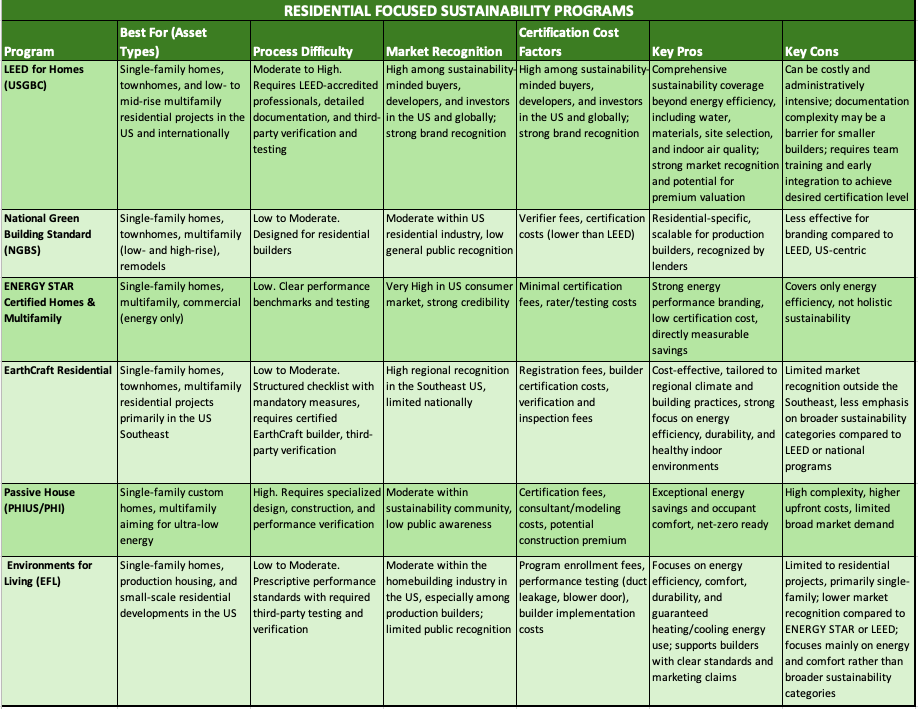
Leadership in Energy and Environmental Design (LEED) – LEED offers global credibility. Investors, tenants, and municipalities recognize it as a mark of quality. Its holistic framework covers energy, water, materials, and health. But it’s documentation-heavy, requiring time, consultant expertise, and careful navigation to avoid chasing easy points over impactful strategies.
National Green Building Standard (NGBS) – NGBS, developed by the National Association of Home Builders and ICC, is tailored for residential projects, including single-family, townhome, and multi-family buildings. It provides practical pathways for energy, water, resource efficiency, and indoor environmental quality. Builders appreciate its flexibility, cost-effectiveness, and alignment with typical construction practices. NGBS carries little brand recognition outside the residential sector, and its marketing strength is more regional than global.
ENERGY STAR – ENERGY STAR focuses specifically on energy efficiency. Certification is straightforward, cost-effective, and well recognized by consumers, especially in the residential market. Homes certified under ENERGY STAR use less energy, save homeowners money, and reduce emissions. The program, however, does not address broader sustainability aspects like site impact or materials selection, so it’s often used alongside other programs for projects aiming for comprehensive environmental credentials.
EarthCraft Residential – EarthCraft is a regional green building program created by Southface and the Greater Atlanta Home Builders Association, designed for the Southeastern US climate. It provides practical, climate-responsive guidelines for single-family, townhomes, and multi-family residential projects, emphasizing energy efficiency, moisture control, and durability. Builders value its cost-effectiveness, flexibility, and strong local recognition, especially with municipalities and utilities offering incentives. However, EarthCraft’s brand recognition is limited primarily to the Southeastern US. Outside this region, its marketability is minimal, and it lacks the national or global prestige of LEED or ENERGY STAR.
Passive House (PHIUS/PHI) – Passive House, under PHIUS (US) and PHI (international), sets one of the most rigorous standards for energy efficiency and thermal comfort. Projects achieve low energy use and superior occupant comfort through strict envelope, airtightness, and ventilation requirements. While its performance benefits are unmatched, implementation can be costly and complex, often requiring specialized consultants and builders familiar with its stringent standards. It’s ideal for owners prioritizing long-term operational savings and carbon reduction over upfront cost minimization.
Environments for Living – Environments for Living is a performance-based program designed for production homebuilders to deliver energy-efficient, comfortable, and durable homes without the burden of heavy documentation. It provides prescriptive guidelines, performance testing, and heating and cooling cost guarantees. While it doesn’t carry the “green building certification” marketing cachet of LEED or NGBS, it is convenient for builders seeking predictable requirements, straightforward implementation, and meaningful homeowner benefits in energy performance and indoor comfort.
To Certify or Not to Certify – That is the Question and Why it Matters
I hear this question all the time from development teams:
“Why should we bother getting an official certification if we’re already designing and building sustainably?”
It’s a fair question. After all, certification adds cost, paperwork, and coordination effort. But here’s the reality. Certification isn’t just about checking a box. It’s about third-party credibility.
Institutional investors, lenders, government agencies, and global tenants don’t want to rely on your internal reports or verbal assurances. They want proof. Programs like LEED, BREEAM, WELL, and regional certifications provide that objective validation. They tell the market your building performs as promised.
Investors and funds use certification as standardized ESG benchmarks. If your building isn’t certified, it may not even make it onto their shortlist. Lenders often provide green financing with better terms for certified projects, seeing them as lower risk and higher value. Tenants, especially large companies with ESG commitments, prioritize certified buildings when choosing where to lease. And government incentives, density bonuses, and tax credits are frequently tied to formal certification. Without it, you could be leaving money on the table.
Advantages of certification include:
- Independent verification of your building’s sustainability performance
- Enhanced marketability and brand credibility
- Access to financial incentives, tax credits, and green bonds
- Preferential financing terms due to lower perceived investment risk
- Structured guidance to ensure holistic sustainability coverage
- Competitive differentiation in crowded markets
But certification isn’t without its challenges.
Disadvantages of certification include:
- Registration, consultants, and documentation costs
- Time investment to meet program requirements efficiently
- Potential design trade-offs to achieve specific credits
Some developers choose to follow best practices without getting certified. For smaller projects or owner-occupied buildings, this can reduce costs and simplify delivery. It allows teams to focus purely on strategies with the strongest ROI, without the burden of formal documentation.
But there’s a trade-off. Without third-party validation, your sustainability claims remain just that – claims. For institutional investors, tenants issuing RFPs, or government agencies awarding incentives, that’s often not enough.
In making your decision whether to certify or not, you need to ask yourself a few additional questions, including:
- Will skipping certification limit your access to certain investors or tenants?
- Are you giving up incentives that could offset the cost of certification?
- Could an official certification boost your project’s marketability and financial performance well beyond what it costs?
In many cases, certification pays for itself. It’s not just a plaque on the wall. It signals the market that your sustainability story is real, verified, and ready for the future.
Educating Your Stakeholders
Your sustainability vision only succeeds with full stakeholder buy-in, and stakeholders most likely have varying goals and priorities. Owners want ROI and risk mitigation. Investors care about value, futureproofing, and ESG compliance. Designers need to see sustainability as a creative opportunity, not a constraint. Contractors want precise specifications integrated seamlessly into the build process. Project managers prioritize scope, schedule, and budget.
Your focus is to show them how sustainability aligns with quality and risk reduction, and tailoring your message to align with the stakeholders’ interests. Use data. Share market trends. Involve each stakeholder early so they feel ownership of the sustainability vision.
Sustainability in Practice
Case Study One – Bundoran Farm and the Green Book
Bundoran Farm, located on 2,300 acres south of Charlottesville, Virginia, was never just about selling lots or building houses. At its heart was a commitment to preserving a working agricultural landscape and protecting the natural beauty, ecology, and heritage of the Virginia Piedmont. The guiding concept behind Bundoran Farm was Preservation Development. This approach balanced thoughtful, low-impact residential development with actively conserving farmland, forests, and wildlife habitat.
Instead of carving up the land into conventional subdivisions, Bundoran Farm:
- Located homesites to avoid productive agricultural areas and critical wildlife habitats
- Maintained large contiguous areas of pasture and forest for continued agricultural use and ecological health
- Integrated roads and infrastructure carefully into the landscape to reduce disturbance
- Created design and development guidelines that prioritized sustainability and environmental stewardship
We quickly realized there wasn’t an existing sustainability program or process that truly fit our goal. We looked at the available programs on the market. Many were strong in certain areas, but none captured our holistic vision for Bundoran. None addressed the full integration of working agriculture, ecological stewardship, and residential development in a way that fits this land and this community.
So, rather than pulling something off the shelf, we created our own guide.
That’s how The Green Book came to be.
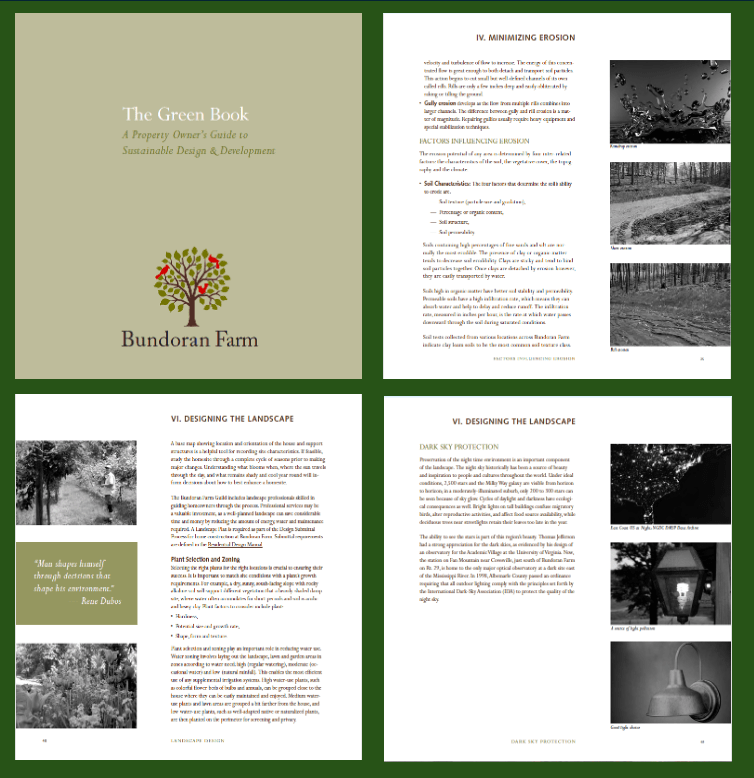
Casey Williams, who at the time served as Bundoran Farm’s Director of Sustainability and Director of the Baldwin Center for Preservation, led the creation of The Green Book. Casey brought a unique blend of expertise, curiosity, and practicality to the task.
She conducted extensive research on best practices in sustainable site planning, construction, landscape design, and building performance. She didn’t just rely on literature or consultant recommendations. She tested assumptions with key stakeholders, builders, architects, engineers, farmers, and environmental experts to ensure the guidance would work in real-world conditions.
What emerged was more than just a set of rules. We crafted The Green Book to reflect the ethos of Bundoran Farm. It explained the “why” behind each recommendation, helping owners, designers, and builders understand how their decisions could support the larger vision of preservation and stewardship.
At the same time, it gave people the practical tools they needed to be successful. It included clear explanations, illustrative examples, and detailed strategies covering everything from protecting mature trees to managing stormwater with rain gardens and permeable pavements.
The Green Book became an inspirational, educational, and instructive document. It guided people to design and build in a way that honored Bundoran’s landscapes, protected its working farms and forests, and created beautiful, durable, and energy-efficient homes.
Most importantly, it helped everyone involved see that sustainability at Bundoran wasn’t about restriction. It was about “living lightly on the land”, contributing to something enduring, and leaving this place better for future generations.
That, in the end, is what made The Green Book so powerful. It wasn’t a generic manual. It reflected Bundoran Farm’s values and a practical roadmap for bringing them to life.
Case Study Two – MWV and A Sustainability Program Appropriate for Merchant Builders
At MWV’s Community Development and Land Management division, designing, building, and operating communities sustainably was one of our core values. As a mixed-use developer with single-family and multi-family residential, hotels, office buildings, and retail establishments, we knew that selecting the right sustainability certification programs was essential. Each asset type and its developer-operator structure required a tailored approach.
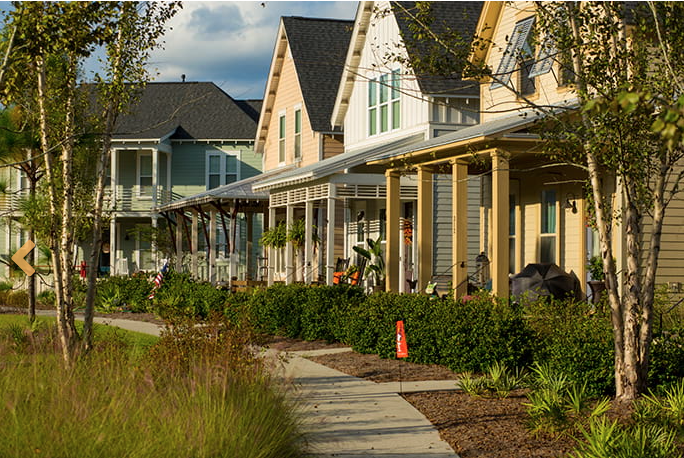
The need to carefully match a sustainability program with an asset type was especially true for single-family homes built by large-volume merchant builders, where predictability in requirements, process, timing, and costs is paramount. At Nexton and Summers Corner, we evaluated programs with our builder partners, including LEED for Homes, EarthCraft, Energy Star, and NGBS. Ultimately, we chose Environments for Living.
Environments for Living isn’t a green certification like LEED or EarthCraft. It’s a performance-based program designed to help production builders deliver more energy-efficient, comfortable, and durable homes. The goals were clear. Reduce energy consumption through better building envelope design, insulation, and HVAC performance. Improve indoor comfort by addressing air leakage, temperature differences, and humidity. Enhance durability through construction methods that minimize moisture problems and improve resilience.
With the Environments for Living program, builders follow prescriptive guidelines and undergo performance testing, including blower door and duct blaster tests. This ensures homes meet defined energy standards that often exceed code. The program even provides homeowners a limited comfort guarantee, becoming a powerful marketing tool.
Why was Environments for Living appropriate for our large-volume builders? Because it integrated seamlessly into their production processes. Builders didn’t have to redesign homes from scratch. Instead, they adjusted construction details and materials to achieve better results in a scalable, cost-effective way. The program offered marketing differentiation through tangible homeowner benefits including lower utility bills and greater comfort.
At Nexton, builders like Pulte and Saussy Burbank participated, giving buyers confidence that their homes performed as well as they looked. At Summers Corner, Environments for Living aligned with the community’s broader sustainability story, alongside native landscaping, water conservation, and walkable design. It ensured builders met a baseline for energy efficiency and comfort without the complexities or costs of programs like LEED.
In short, Environments for Living helped us align production builders with our community goals, delivering practical, affordable, and marketable sustainability to residents.
Case Study Three – Qiddiya and how Sustainability sits at the heart of Saudi Arabia’s Vision 2030.
The Kingdom of Saudi Arabia knows it can’t rely on oil forever. As part of Vision 2030, Saudi Arabia is pivoting to a diversified economy. Vision 2030 isn’t just about economic growth. It’s about making sure that growth goes hand in hand with environmental responsibility. It is about creating places that are resilient, resource-efficient, and livable for generations.
When I was Executive Director of Planning and Design at Qiddiya, these ideas weren’t abstract. Qiddiya is a new entertainment, sports, and cultural destination being built just outside Riyadh. Designed to become Saudi Arabia’s capital of entertainment, Qiddiya will feature theme parks, motorsport tracks, sports arenas, outdoor activities, arts venues, and cultural events. It’s part of the country’s push to improve the quality of life for its people while creating jobs and economic opportunities beyond oil. At over 360 square kilometers, Qiddiya isn’t just large, it’s a city-scale project that will redefine leisure and tourism in the Kingdom.
I had worked on green initiatives before, but Qiddiya was on an entirely different scale. The complexity meant we had to engage some of the best minds in sustainability, particularly those with deep experience in the Middle East.
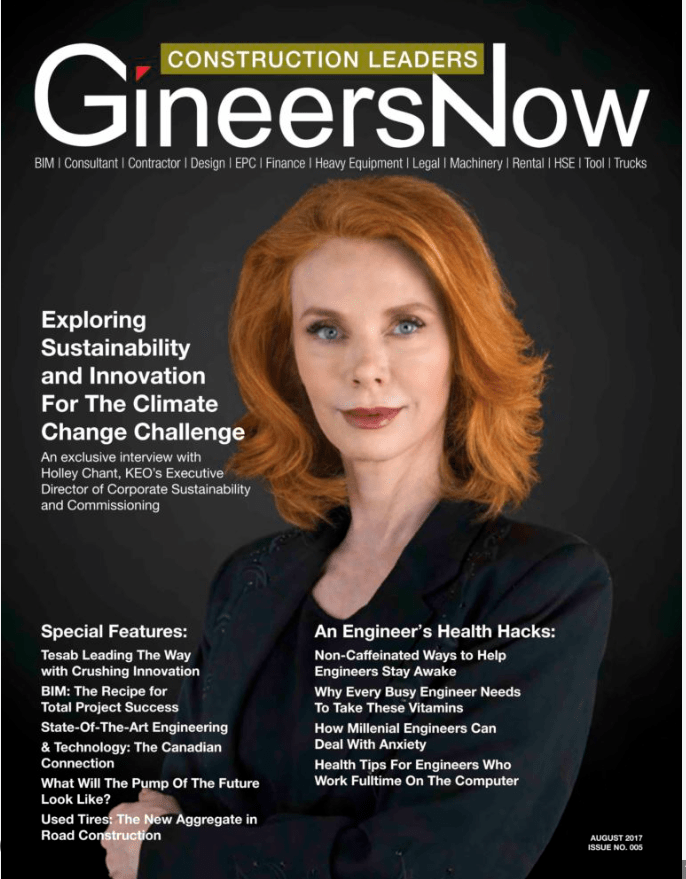
Holley Chant joined our team as Director of Sustainability and Environment for Qiddiya Investment Company. With over two decades of experience driving environmental change, she brought clarity and rigor that elevated the entire team. She integrated green building standards across master planning, infrastructure, public spaces, and entertainment venues, aligning Vision 2030’s environmental goals with what was being built on the ground. Her work ensured sustainability was embedded from the start, not bolted on later.
Qiddiya integrated ESG principles from day one, including smart-city infrastructure, renewable energy systems, electric mobility options, and intelligent transportation networks. On the construction side, the team used technologies like BIM and modular construction to optimize material use, reduce waste, and improve delivery. We aligned with LEED, GSAS standards, and International Green Building Code to ensure performance across energy, water, materials, and operations for the whole life cycle.
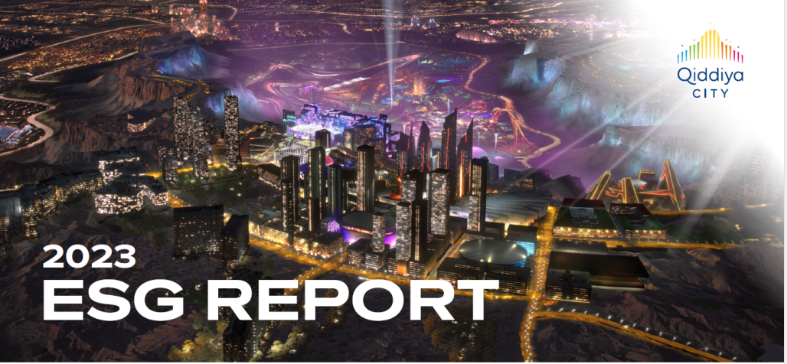
Once operational, Qiddiya will run on a renewable-focused energy model, with water conservation strategies built into attractions and facilities. Holley’s influence went beyond project delivery. She mentored emerging Saudi talent entering the sustainability field. Her impact raised the bar on accountability and environmental performance across the region. She helped shift sustainability from an add-on to a core design strategy. That mindset change will define how these developments shape the country’s future.
Final Thoughts
Sustainability isn’t about adding complexity to your project. It’s about building with intention. It’s about thinking deeply and caring enough to act. When you embed sustainability from the very start, you’re not just checking boxes for compliance or marketing. You’re creating places that work better for people, perform better financially, and leave a lighter footprint on the planet.
Whether you’re crafting design guidelines for a community like Bundoran Farm, selecting the right program for production homebuilders, or shaping a mega-project like Qiddiya, the principle is the same. Start with a clear sustainability vision. Engage your team and stakeholders early. Choose tools and programs that align with your goals and context. And remember, certification isn’t just paperwork. It’s proof. Proof that your promises are real and your project is future-ready.
Here’s the truth.
The world is moving fast. Investors are demanding more. Tenants are expecting better. Regulations are tightening. Climate impacts are intensifying. Waiting to “figure it out later” is no longer an option.
Make sustainability part of your foundation today, not an afterthought tomorrow. Projects that do will stand apart. They will attract capital, tenants, and community support. They will endure.
And they will position you as a leader in creating places that matter – for your clients, your community, and the world we all share. The time to act is now.
 The Barnes Perspective: Thoughts, Ideas & Lessons Learned from Joseph Barnes
Leave a comment